Approximately 83% of data migration efforts exceed their timelines and budgets or fail altogether. Intranet migration has long been one of the most complex and risk-prone initiatives organizations undertake.
Whether you’re moving from a legacy system to SharePoint or modernizing your digital workplace, the process involves thousands of files and high stakes for employee productivity.
Moving content isn’t the only challenge. The trick is moving it correctly and efficiently in a way that sets your organization up for long-term success. Here are some common challenges you’ll encounter during a digital workplace migration:
- Manual data mapping
- Content duplication and inconsistencies
- Broken links and permissions errors
- Long timelines and employee disruption
AI intranet tools can make your migration and intranet implementation much faster and less stressful. With artificial intelligence, you can automate, validate, and use intelligence tools to set your team up for success. Here’s a closer look at AI-powered solutions to make your intranet migration seamless and more efficient.
Why Intranet Migration Projects Often Fail
Intranet migration efforts rarely go off the rails due to a single issue. Usually, several different factors are at play, including:
- Legacy Intranet Challenges: Disorganized content, outdated information, and a lack of governance and ownership
- Manual Migration Risks: Human error in data entry and mapping, as well as inconsistent formatting, create migration risks.
- Business Impact: Migration headaches lead to delayed launches, lower adoption rates, and an increased IT workload
Before starting your migration journey, identify these risk factors. Some threats may be larger for your organization than for others. When you know what you are up against, you can more effectively prepare for these barriers and keep your migration project on schedule.
AI Accelerates Intranet Migration, but It Doesn’t Replace Expertise
Artificial intelligence is incredibly effective at handling repetitive, error-prone tasks such as classification, validation, and automation. But successful intranet migrations still rely on human experience, governance, and business context.
Without proper oversight, AI can simply move outdated or poorly structured content faster — creating new problems in a new environment. The most effective migrations combine AI-powered efficiency with expert guidance to ensure content quality, security, and long‑term adoption.
How AI Transforms the Intranet Migration Process
Adding AI to the mix can reduce migration errors through:
Automated Content Mapping & Structuring
Mapping out your existing content is one of the most tedious and time-consuming processes during a migration. AI can identify relationships between old and new content structures, automatically categorize and tag content, and reduce the effort spent on manual mapping.
Thoroughly mapping your data is the first step to a smooth migration. The reality is that not everything needs to be brought over to the next environment. You want to eliminate duplicate and outdated content so that the intranet is cleaner.
Intelligent Data Validation to Reduce Errors
AI runs validation checks throughout migration. It will flag:
- Broken links
- Missing metadata
- Duplicate content
By using AI for intelligent validation, you can ensure that all your data is clean and usable before bringing it into the new intranet environment. If you bring unclean data and duplicate information to the intranet, it can create serious downstream issues and make the environment less user-friendly. AI helps prevent this.
Workflow Automation for Faster Migration
The biggest intranet migration time savings come from workflow automation. Artificial intelligence automates several tedious, frustrating tasks that can slow you down, such as:
- Transferring files
- Assigning permissions
- Formatting content
You can take weeks or even months off your project timeline by using AI to reduce manual effort, while keeping experts focused on governance, structure, and decision‑making. You’ll also reduce the administrative burden on your IT team, ensuring they have the bandwidth to assist with day-to-day operational tasks. If you can minimize the need for outside IT support, it will be much easier to keep your project on budget.
AI-Assisted Content Creation & Optimization
An intranet migration is the ideal time to revamp your content and refresh internal assets to keep them relevant and engaging. Artificial intelligence tools can rewrite outdated content for you and do most of the heavy lifting for your HR team.
While you should keep people in the content-creation workflow, they can primarily serve as editors, fine-tuning documents rather than creating content from scratch.
Focus on standardizing the tone and branding of your assets. Getting all of your content aligned will help the internal communications team scale faster.
Predictive Insights & Migration Recommendations
Artificial intelligence can deliver timely insights for your migration team. AI identifies:
- Redundant content
- Low-value pages that should be archived
- Opportunities to improve structure
With AI, your team can make smarter decisions faster and reduce waste. Your workforce will devote its time and talent to creating an engaging intranet environment.
Why AI Alone Isn’t Enough for Intranet Migration
While AI plays a critical role in accelerating migration, it isn’t a replacement for strategic planning or hands-on experience. Intranet environments are deeply connected to governance, compliance, permissions, and day-to-day team operations.
Relying solely on generic AI tools or outsourced migration services can introduce risk — especially when content ownership, security, and accountability are unclear. AI works best when applied intentionally, within a controlled framework guided by people who understand both the business and the platform.
Real Business Impact: Faster Migration, Fewer Errors
An AI-driven intranet migration is significantly faster and easier compared to a traditional migration. By incorporating artificial intelligence into your migration journey, you can unlock benefits such as:
- A faster deployment timeline
- Reduced reliance on IT resources
- Lower risk of data inconsistencies
- Improved employee experience from day one
Implementing a new intranet platform is a huge investment. AI helps you achieve a stronger ROI and a shorter time-to-value by delivering the new environment faster. You can immerse your team in engaging content that answers key questions and supports higher productivity while on the clock.
How hubley Uses AI to Simplify Intranet Migration
With hubley, organizations combine AI-powered automation with intranet expertise to migrate confidently without handing critical data over to unmanaged vendors or black‑box AI tools.
hubley uses artificial intelligence to reduce manual effort and errors, while keeping people in control of governance, structure, and long-term success.
AI-Powered Guidance for Employees and Admins
AI governance is a game-changer for businesses seeking a faster and more effective way to keep intranet content under control. The hubley Help Bot guides users through each major process and reduces errors during setup and usage. If you follow the process step by step, you can reduce your need for rework.
When you pair the Help Bot with clear ownership roles, the entire migration becomes clearer. Everyone knows what they are responsible for, and the Help Bot guides them as they carry out their assigned tasks.
Smart Governance and Content Optimization
Together, AI and SharePoint tools from hubley facilitate smart governance. AI identifies gaps in:
- Content quality
- Compliance
- Structure
Once subpar content has been identified, you and your team can make adjustments to promote better employee engagement in the new environment.
Automated Workflows Built Into Microsoft 365
The hubley platform seamlessly integrates with SharePoint and Outlook, which eliminates duplication and manual processes. Integrating your intranet with Microsoft Teams and other tools your team already uses will reduce app fatigue. The goal is to put essential productivity tools at your employees’ fingertips.
AI Search & Knowledge Discovery
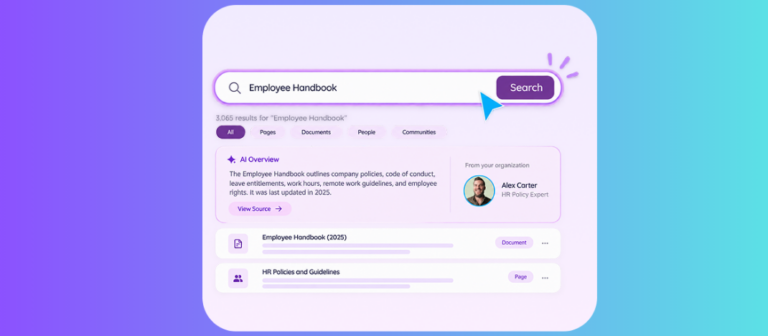
Once your intranet is live, built-in artificial intelligence tools will help your employees effortlessly find the assets they need to do their jobs. Employees can find the right content instantly, reducing reliance on outdated or duplicate assets. AI search improves adoption after your migration, yielding stronger ROI and a shorter time-to-value.
Best Practices for an AI-Driven Intranet Migration
Want to use artificial intelligence to support your intranet migration? Here are some steps to take:
- Audit and clean content before migrating
- Define governance and ownership roles early
- Prioritize the employee experience to maximize adoption rates
Use AI throughout the process for tasks such as classification, automation, and validation — while ensuring experienced stakeholders guide governance, ownership, and final decisions.
Why AI Is the Future of Intranet Migration
AI intranet is shaping the future of how businesses connect with their workforce. With artificial intelligence at your disposal, you can move on from traditional migration processes, which are slow and prone to errors. AI-driven migration is faster, more scalable, and largely automated. As digital workplaces get more complex, adopting AI is essential.
Get Started With a Smarter Intranet Migration
Don’t embark on an intranet migration journey the old-fashioned way. Manual processes set you up for failure and can increase the risk of costly delays. Some manual migration projects may fail altogether.
Artificial intelligence-powered intranet migrations are simply smarter. You can move to your new environment faster, with fewer errors, and achieve better results. When the new environment is engaging and frictionless, your employees will want to participate.
A successful intranet migration requires more than speed — it requires clarity, governance, and adoption from day one.
hubley delivers AI-powered intranet migrations guided by real expertise, so organizations can modernize without sacrificing control or security.